← Back to the magazine
How to Put Volunteer Work on a Resume So It Reads as Experience
Volunteer hours count, but only when you write them like a job. Here is where to put them and how to phrase the bullet.
Volunteer hours count, but only when you write them like a job. Here is where to put them and how to phrase the bullet.

Volunteer work counts as real experience when you write it like a paid job: a strong verb, what you did, and what changed because of it. Put the one role that matches the posting in your main Work Experience with (Volunteer) in the title, and shrink or cut the rest.
You spent the last two years coaching a Saturday youth team and running the sign-in desk at a community food bank. Real hours, real responsibility, nobody paid you. Now you are filling in a resume and you hit the question everyone with unpaid experience hits: does any of this count, and if it does, where does it even go?
It counts. The mistake most people make is treating volunteer work as a moral footnote, a line at the very bottom that says "I am a good person." Recruiters do not hire on character points. They hire on evidence that you can do the work. Volunteer experience carries that evidence as well as any paid job, but only if you write it like one.
The takeaways
Yes, and hiring managers say so out loud. The Deloitte survey above found that 82% of them weigh volunteer experience the same way they weigh a paid role when they size up a candidate, while it appears on only roughly a third of the resumes they see. So the experience counts, and listing it puts you in a minority that benefits from it.
The catch is in the word "experience." A manager is not impressed that you gave time to a cause. They are reading for the same things a paid job proves: that you showed up, coordinated with people, hit a deadline, owned an outcome. Coaching a team is people management. Running a food drive is logistics. A treasurer seat on a club committee is budgeting. The skills are real and transferable. Your job on the page is to name them in the language a recruiter already reads in, so the unpaid label stops mattering.
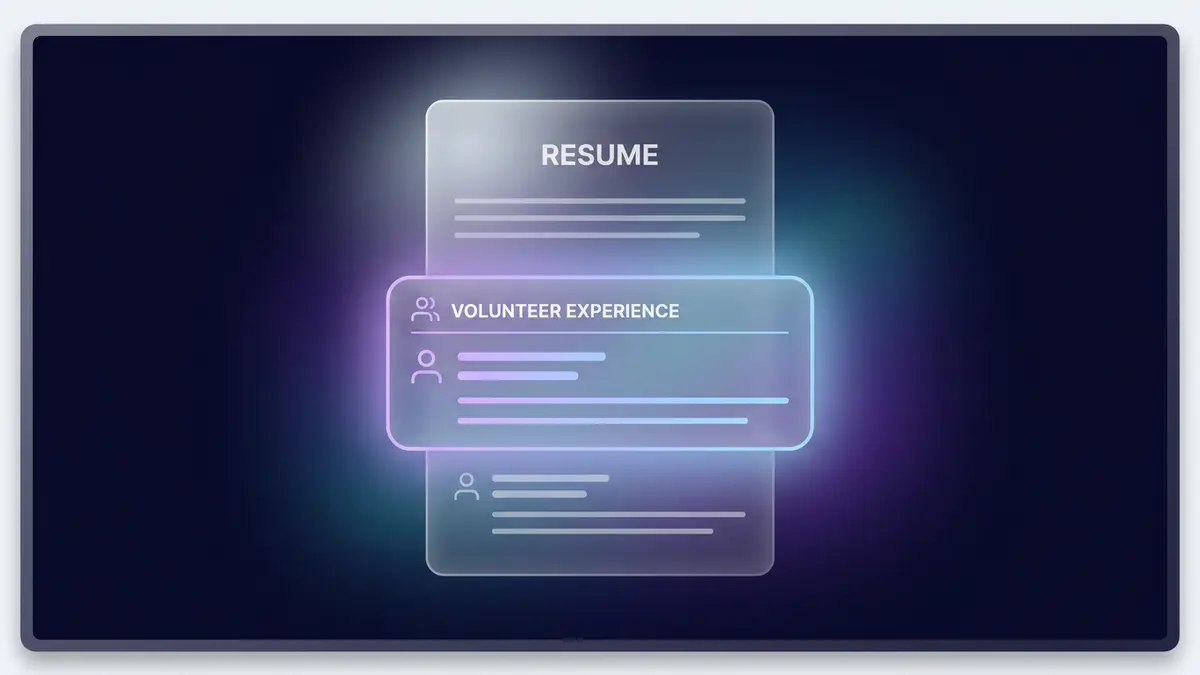
It depends on one thing: how close the role sits to the job you are applying for. If a volunteer role used the same skills the posting asks for, put it in your main Work Experience section, beside your paid jobs, with "(Volunteer)" in the title so nobody thinks you dressed up a salaried role. That placement tells a recruiter you consider it serious experience, and it keeps your strongest, most relevant material near the top where the first scan lands.
If the work is worth showing but off-topic for this role, give it a short "Volunteer Experience" block lower down, after paid work and education. And if you are early in your career or filling a gap, volunteer work earns more room than it would otherwise, because it is doing the job your thin paid history cannot yet. The post on writing a resume with no experience walks through that promotion in detail.
Use the same shape as any job bullet: a strong verb, what you did, then what changed because you did it. The structure is identical whether the work was paid or not, and that structure is what turns a charity line into proof.
Take the food bank. The weak version names the activity and stops:
Volunteered at a local food bank.
The version that earns a read names the action and the result:
Coordinated weekend intake for a food bank serving ~120 families; cut sign-in wait from 40 to 15 minutes by reworking the queue.
Same shift, same hours. The second one shows logistics, initiative, and an outcome a manager can picture. Do the same with a coaching role, a fundraising drive, or a committee seat. You are not inflating anything, you are describing real work in usable terms. The same move that quantifies any resume bullet with a result works here, paycheck or not.
Often, honestly. If you already have relevant paid experience that fills the page, an unrelated charity line is dead weight that pushes your strongest material down. A single fun-run, a one-off donation drive, anything you could not talk about for two minutes in an interview: leave it out. Listing it does not read as well-rounded, it reads as padding, and padding is where vague claims hide.
Two more judgment calls. Volunteer work that signals religious or political affiliation can invite bias you cannot control, so weigh whether this employer needs it. And dates that stopped years ago add little unless the role itself was substantial. Whether you draft your resume by hand or with a tool like Jobscalr, the test does not change: every line has to be something true that earns its space and that you could defend in the room. Keep the volunteer entries that pass it, and browse the rest of the résumé guides for the sections around them.
Sharpen your next application.
See your honest match score before you send, then tailor your CV and cover letter to the exact posting. Your first analysis is free.
Put this into your next application.
See JobScalr →